• Skip to primary navigation
  • Skip to main content
  • Skip to primary sidebar

Az Samad Lessons

Guitar, Ukulele and Music Lessons

  • About
  • Lessons
  • Music Reviews
  • Music Gear Reviews
  • Book, Video & Course Reviews
  • Features and Interviews
  • Podcast
  • Creative Fridays
  • Store
  • Contact

Naskah Percuma Surat Muzik – Az Samad

August 7, 2019 by azsamadlessons 1 Comment

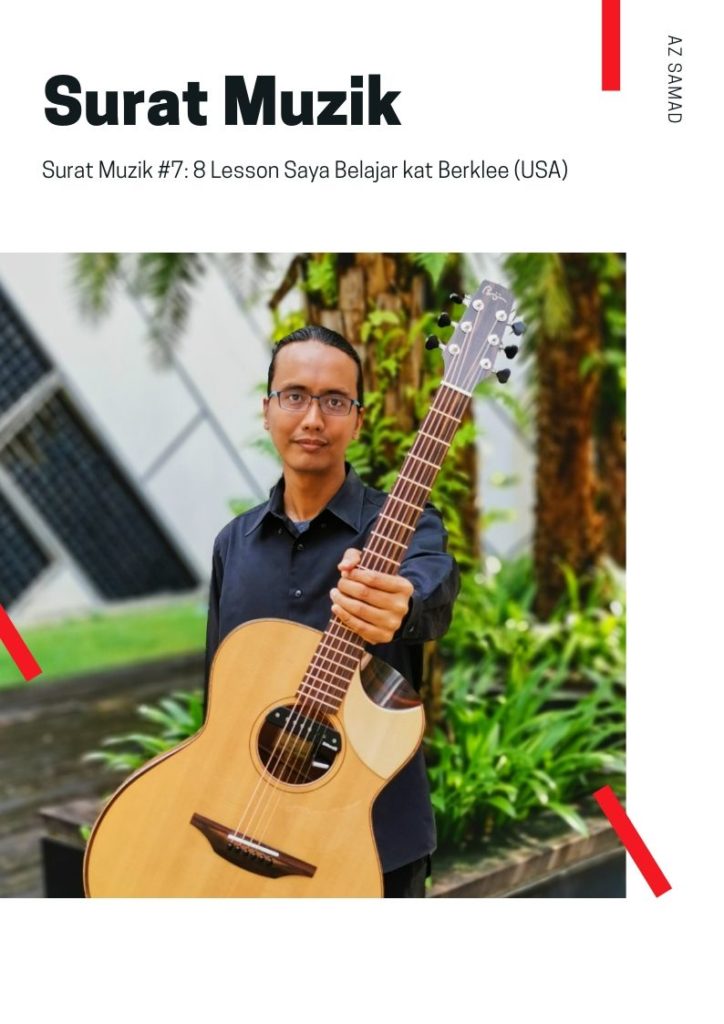
Kepada yang ingin tahu apa itu “Surat Muzik”, ini edisi contoh – naskah Surat Muzik yang ketujuh, selamat dikirim pada 15 Julai 2019.

Klik pada gambar di atas (atau DI SINI) untuk muat turun fail PDF ‘Surat Muzik’

Boleh baca & kalau suka, boleh sertai & dapatkan naskah seterusnya di sini: https://sendfox.com/lp/03z761
Filed Under: Beyond Music, Philosophy, Practice Secrets Tagged With: az samad, az samad jazz guitar, berklee college of music, berklee college of music alumni in malaysia, Surat Muzik

An Exclusive Interview with Prawit Siriwat & Daniel Durst

October 1, 2026 by azsamadlessons Leave a Comment

In this exclusive feature, we sit down with guitarist Prawit Siriwat and bassist Daniel Durst to discuss their creative journey, musical growth, and latest collaborative release.

Prawit and Daniel share a 15-year musical partnership that first sparked in their college dorms at The New School in New York City. From early late-night jam sessions and free improvisation experiments to restaurant jazz gigs and acoustic folk songwriting, their shared vocabulary culminates in their intimate duo EP, Let’s Play Sometime, which I recently reviewed here.

There will be the next single “Water Park” out on Oct 9 before the full EP drops later this month, on Oct 30, 2026.

In this interview, we dive into their compositional process, translating solo acoustic pieces to duo arrangements, gear choices (including Waterloo Guitars), impactful lessons from mentors like Steve Cardenas and Jane Ira Bloom, navigating the music scenes across NYC, LA, and San Francisco, and invaluable advice for emerging musicians.


1. The new EP is with your good friend of 15 years, bassist Daniel Durst. How did your personal and musical relationship with Daniel Durst evolve from those early dorm room jam sessions into the conversational dynamic heard on Let’s Play Sometime?

Prawit: First off, Daniel is just an awesome dude to hang out with. In our first years of college, we had a lot of fun checking out new music together, exploring different parts of New York, and getting to know the scene as these 18 to 19 year old kids. We started by playing standards in the dorm rooms. Then we both developed parallel interests in free improvisation. I think in our sophomore year we started exploring this and recording in our dorm room with a Pro-tools Mbox and one cheap condenser mic. 

As we started getting hired in New York, we ended up playing in bands together a lot. This resulted in a shared growth, we learned how to navigate musical problem solving together. All the while, we played a lot of background gigs as a duo or trio with drums or a horn player, playing jazz at restaurants and bars. 

Eventually we recorded two completely free improvised albums entitled Wit & Daniel Make a Record Vol. 1 and Wit and Daniel Make a Record Vol. 2. The first volume was recorded in my apartment and the second was at our friend Eva Lawitts’ recording studio. I also hired Daniel to be on my first trio record. He’s been such a huge part of my compositional and professional development that when I think of bass, his sound is usually the first thing that comes to mind. 

In 2021 I moved to California. For about a year or so I didn’t get to play with Daniel as much. I definitely missed him a lot. Then he moved out to LA a few years later, and we got back into playing again.  At this point I had started writing a lot more music for acoustic guitar, so we started introducing that into our duo playing. We also started accompanying our good friend, Ruby Greenberg, and started developing a vocabulary around the acoustic-folk-songwriter universe. And that sort of led to the songs on Let’s Play Sometime.

Daniel, what about you? How did your musical relationship and playing evolve with Prawit over these 15 years, culminating in the new EP? Could you share your take on this?

Daniel: Prawit and I have been playing in a myriad of musical contexts from jazz to rock music to noise and free improvisation. Between being on the same gigs and our duo project, we’ve been through a lot together professionally. I think that each musical zone that we have visited formed and strengthened our abilities to interact and communicate through music. I also feel like our friendship outside of music has created a deep sense of trust and camaraderie that translates to our performances. When we hang, we mostly talk about food and shoot the shit. However each time we play, I’m always reminded of how deep of a player Prawit is and how much fun it is to play with him. Playing with Prawit, I feel as though I don’t even have to think – I can just let the music happen. 


2. The track “Nature Walk” originally appeared on your solo acoustic EP before being reimagined here as a guitar-and-bass arrangement. What was the process like translating a solo acoustic piece into a duo with Daniel, and did your approach to it change in any way for it to be a duo performance?

Prawit: Our approach to arranging is usually pretty organic. I trust Daniel’s intuition and he has some of the best ears in the business. Sometimes he knows the chord I’m going to play before I know the chord I’m going to play. We started playing the tracks from the Nature Walk EP at a couple gigs, and over time we settled into a way of playing it together.  We had a few sessions at my apartment where we went over the songs.

Daniel, what’s your perspective on this? Could you talk a bit about how you approach creating your parts on the track? How much is composed, how much is more open/improvisational for this piece?

Daniel: I try to treat “Nature Walk” the same way I treat pretty much any other song by focusing on supporting the melody. I think Prawit gave “Nature Walk” some natural ebbs and flows in how the momentum builds and dissipates. The bassline has some specific movements, but there’s a lot of choices to be made with regard to register, dynamics, and how much space to leave in each section. For the first few times we adapted it to duo format, we treated it as a once through the melody type of piece like it appeared on Prawit’s solo record. Shortly after, we began organically improvising through the harmony and embellishing the melody a bit more.

3. Your compositions on this record effortlessly bridge folk, 1980s Windham Hill fingerstyle textures, video game score aesthetics (“Night Walker”), and chamber jazz. How do you approach that, and was this whole genre blending thing something that came naturally or did it evolve over time? How did this really happen?

Prawit: I appreciate that you’ve heard these influences. I think when I dig something that I hear, I get curious and I try to absorb as much of it as possible. I’m a huge fan of Jim Hall’s work with Jimmy Giuffre for the chamber jazz side of things. I was digging Alex de Grassi and Hiroya Tsukamoto when I was writing “Water Park”. I think it lead me down a path of checking out several of those Windham Hill records. I stumbled upon Michael Hedges Aerial Boundaries And de Grassi’s Southern Exposure in a used record bin. With “Night Walker” I had just watched Princes Mononoke and just started plunking at our piano. I think I don’t think in genre very much when I sit to write. My process of learning just takes in a lot of information. Then when I write it all comes out. Though I’m starting to see the appeal of writing specific volumes of music in a genre. John Zorn does that in a huge range of music. 

4. The EP closes with a beautiful version of Henry Mancini’s “Moon River,” carrying subtle Bill Frisell-inspired nuances. Why was this particular classic the right choice to close out an otherwise original EP, and how did you approach it?

Prawit: I started playing “Moon River” at solo-guitar nursing home gigs. There was something really heartfelt and nostalgic about it. I remember watching Breakfast at Tiffany’s and scenes from the movie coming up every time I played the tune. It just felt nice. Then I started playing it with Daniel in both a jazz trio and in our duo setting. With the acoustic guitar and the key of G, it felt like it aesthetically fit, yet the mood contrasted with the rest of the material on the EP. 

Daniel, as the bassist, how did you approach framing such a classic, well-known standard to give it a fresh vibe?

Daniel: I feel like we didn’t discuss our approach to it much beforehand. I think having an open intro that weaves into the beginning of the melody is something that just came naturally by playing the song many times on gigs together. I just try to let the melody speak for itself since it’s already so compelling.

5. You earned your BFA at The New School studying with folks like Steve Cardenas, Julian Lage, and Jane Ira Bloom. Looking back at your time working with them, what were some of the most memorable lessons that shaped your current approach to playing guitar? Could you share a story or two of lessons or experiences with them that were life-changing?

Prawit: I was extremely fortunate to have some very open minded and forward thinking teachers at The New School. Even more lucky that the first private lesson teacher they paired me up with was Steve Cardenas! I remember in one of our lessons, I was struggling to figure out this tune for a class, and Steve asked me why I wanted to learn the song.  At the time I wanted to learn everything and as much as possible to be a “better” musician. But something he said really stuck. He told me that you really only need to learn the songs that you have a connection to. Obviously that’s not always the case when you’re learning songs for a class or something.  But this taught me two things. Learn the songs that matter the most to you, and if you have to learn something that isn’t a song you have a relationship to, try to find what connects you to the song first.  

Similarly, Jane Ira Bloom taught a composition class and gave me the opportunity to explore textures with pedals and dig deep into some of the parts of my innate musical identity. Instead of just learning how to execute new “jazz” material, she allowed us to bring in personal influence and translate it into something new. 

Julian was mostly just fun to play tunes with. He had some great advice for how to integrate the body and the guitar. I feel like at the time I didn’t have the experience to ask him the questions I would ask him now. But I definitely learned a lot from just playing with him. I recently had an injury and some of what Julian and I talked about helped me approach the guitar again in a healthy way. 

There are so so so many more stories from amazing teachers, I’ve loved a lot of lessons and they really stick. There’s a very restrictive downside to music school sometimes, and I definitely experienced it. I’m glad I was fortunate enough to still have a lot of good experiences too. 

Daniel, how about you? Could you share a story or memorable experience as well during your time at The New School with Ben Street, Bob Cranshaw and Jane Ira Bloom?

Daniel: Prawit and I were both in Jane Ira Bloom’s “Linear Composition” class. I remember one composition assignment was to record an improvisation immediately after waking up in the morning and to later formulate a composition centered around that. To this day, I still use that exercise as a compositional jumping point. Bob Cranshaw and Ben Street were both amazing teachers as well and I am very grateful for my time I spent with them.

6. Your discography spans delicate solo fingerstyle (Nature Walk), intimate duo interplay (Let’s Play Sometime), and electric trio (Blueberry with Daniel Durst and Abel Tabares). How does your approach to guitar change in different settings?

Prawit: I think all the environments inform each other. Each setting presents a different set of parameters for listening and responding, and each time they come up, it teaches me something about how to respond in another setting. To me it really feels like I’m still the same musician, employing the same skills, just the atmosphere may feel different. But it all comes down to listening deeply and responding empathetically. 

7. Having performed across diverse New York venues like The Stone, National Sawdust, and Bar Next Door, how has performing, living – basically being a musician in New York City shaped your career? I’m especially curious about whether it was different when you were a student at The New School, and then as a working musician. 

Prawit: The New York gig environment that I remember coming up in felt very rigorous. It demanded professionalism and a high level of execution. It taught me the importance of preparation. It also made me dig into techniques to improve focus. There’s a lot of distractions before you hit the stage. Sometimes you have to quiet the life stuff so you can become a vessel for conveying the art to the audience. 

I think as a student, I was way more focused on being a certain type of “professional gigging jazz musician”. It was training mode. Get the skills to execute correctly. I did get the opportunity to lead a band at the Bern Jazz Festival through The New School. That was a lovely experience. But yeah, a very different approach to the “Art” of it all. In school, we’re also under 21 and many of the venues in the city are 21+. So it created a barrier unless you went out and got a fake ID or something. 

How about you Daniel, for you coming from the San Francisco Bay Area, moving to New York City and now being based in Los Angeles – maybe could you talk about how these different cities shaped your career?

Daniel: I think each city and each scene has taught me so much and taken me to many unexpected places. I first fell in love with music in the Bay Area and my first experiences performing music were through my high school and local dive bars in San Francisco (shoutout Thee Parkside and The Rite Spot!). I am immensely grateful for my experiences in NYC where I got to learn from its rich musical communities. I have many fond memories running back and forth between standards gigs in the village to DIY basement shows in Brooklyn. Los Angeles has been a nice scene to explore and I’ve met so many wonderful musicians here as well.

8. You have a very personal expressive sound on your Waterloo Guitars Waterloo WL-12 acoustic guitar. Why does that guitar speak to you and how did you end up becoming a Waterloo Guitars artist? 

Prawit: I was first introduced to Waterloo Guitars when I was on a search for a high quality steel string to accompany singers. This store in Austin, Texas had the whole line. This was back in 2016 when there were a lot more on the market. The 12 fret seemed to feel familiar to me. I was studying classical guitar on and off with Adam Rogers. That world seemed to cross-over really well. I didn’t know it at the time, but the maple back and sides also made the guitar respond a little bit more like a jazz archtop. Immediate response with a bloom, but not too much overtone. It became my only steel string, and it re-ignited what got me started on the guitar. My first guitar was a Johnson Dreadnought. I used the Waterloo with singers mostly for a while, then started writing on it for songs with my electric trio. Then when I moved to California, I had a little extra time. In some introverted moments, I started developing a body of work for solo acoustic guitar. 

I had been familiar with guys over at Collings/Waterloo over the years with questions about the guitar. Mark Althans is the man! Eventually I met the team at NAMM and one thing led to another and they added me to the site. I think at the same time I was just getting more integrated into the community of acoustic musicians. I taught lessons at Organic Sounds Select Guitars in Santa Ana, CA. I met Teja Gerken and did a show with him at the shop. I also have known Charlie Rauh, who was an early artist for Waterloo, for a long time. The whole thing is very communal.

9. Lastly, could you share a piece of advice for younger musicians who want to write, record and release their own original music? 

Prawit: I don’t  like to give blanket advice, but I do love working with my students and hearing what specific hurdles they need to get through to do this stuff. I think this is a common thread based on my own experience and mistakes. Be rigorous, reach for the highest form of music that you want to make, but don’t confuse patience with stalling. Get the music out in the world. The future is not guaranteed so just get it out.

And for Daniel, could you share a piece of advice as well for younger musicians who want to aim to be active as a musician like yourself? Maybe advice you would give your 17 year old self, with the benefit of hindsight now?

Daniel: If I could speak to 17 year old Daniel I would simply tell him to sing more.

That’s beautiful advice to close this interview. Thank you so much for doing this. Appreciate your time. All the best for the EP release soon, and am happy we could connect!


A huge thank you to Prawit Siriwat and Daniel Durst for taking the time to share their artistic journey, career lessons, and personal reflections in this interview!

I hope this interview was insightful for you as it was for me.

Be sure to stream and purchase Let’s Play Sometime on all major platforms to support their music when it is released on Oct 30, 2026. Listen to the next single, “Water Park” on Oct 9!

Follow Prawit Siriwat for updates:
https://www.prawitsiriwat.com
https://www.instagram.com/prawitsiriwat
https://www.youtube.com/prawitsiriwat

For more artist interviews, guitar lessons, and creative insights, stay tuned right here on https://azsamadlessons.com/

===

I rarely do interviews but from time to time do single, EP and album reviews. Here’s more info about that:

[Submissions for Review Consideration]

If you are an artist, record label or press outreach interested for me to feature your new release on this site, please email me at azsamad3 at gmail dot com.

I prefer physical CD submissions whenever possible alongside streaming/download links. Do not attach any files to the email but include Dropbox/Google Drive links.

I cannot guarantee a review for every submission & if I’m not too into it, I may opt not to review it. I mean, it’s better to get a good review that for me to write a bad review just because it’s not a match for the kind of stuff I dig right? :p

NOTE: All reviews reflect my honest personal opinion so be aware that I will point out both cool Pros and Cons that I see in the work. Thanks!

Filed Under: Interviews, Jazz, Music Business, Music Theory, Philosophy Tagged With: Daniel Durst, Musician Interviews, Prawit Siriwat, The New School

  • Page 1
  • Page 2
  • Page 3
  • Interim pages omitted …
  • Page 611
  • Go to Next Page »

Primary Sidebar

Search for a topic, review or lesson:

Recent Posts

  • An Exclusive Interview with Prawit Siriwat & Daniel Durst
  • Music Review: Let’s Play Sometime by Prawit Siriwat and Daniel Durst
  • Book Review: Exploring Jazz Arranging – Revised Edition By Chuck Israels (Sher Music)
  • Book Review: The Real Intros and Endings Book By Tony Corman (Sher Music)
  • Ulasan Buku: Brader, Kita Mesti Terus Hidup oleh Nasir Jani

Categories

Buy Me A Coffee

Hi Az Samad here! I am disclosing that I’ve included certain products and links to those products on this site that I will earn an affiliate commission for any purchases you make. 

Whenever possible, I've tried to include a mention that the link is an affiliate link but since the site is so big by now, I'm including this note so so that you are aware.

That being said, as I always mentions - all reviews reflect my honest opinion of the book/course/product. My goal is not to recommend everything to everyone but to give you as much information about my experience with it so that you have a better idea whether it might be for you (or not).

Copyright © 2026 · Genesis Sample on Genesis Framework · WordPress · Log in