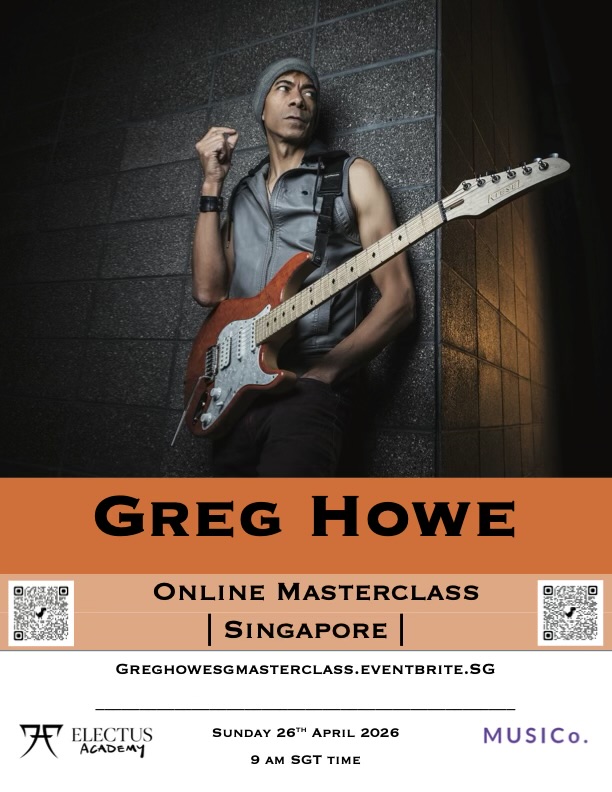
Recently on Sunday, 26 April 2026, I had the opportunity to attend the Greg Howe Online Masterclass. It provided a comprehensive look into the career and technical approach of the iconic guitarist.
The 2-hour session was divided into three core segments: Howe’s musical journey, his approach to guitar playing over the years with an introduction to his harmonic concepts, and an interactive Q&A session.

Part 1: Life Story and Musical Journey
Greg Howe’s journey began recounting his ability to learn solos by ear and how it felt natural to him. I loved how his love for music shines throughout the time he told his stories. A pivotal moment was the release of the first Van Halen album, which Greg described as a “gamechanger.”
After witnessing Eddie Van Halen’s tapping live, Greg became the first in his circle (in his town) to “crack the code” of the technique. He also talked about how even in music magazines back then, the transcriptions were not correct yet and misinterpreted Van Halen’s tapping technique.
Greg shared how his professional solo artist career was launched when he bypassed the standard PO Box submission process and sent a demo via FedEx directly to Mike Varney at the Guitar Player office. Getting the attention of Mike Varney, this led to Greg’s self-titled first album back in 1988. This was where audiences first heard his approach to tapping, a technique born from a need to solve specific technical problems rather than just for show.

Part 2: Harmony and Superimposition
Howe discussed his transition from rock into fusion-influenced playing, noting that his style developed naturally by combining his diverse influences, such as Larry Carlton and rock players, without strict compartmentalization. For Greg, all the different styles were just music that he listened to, and naturally they all influenced his approach to playing guitar.
A major highlight for me at this point was Greg talking about his superimposition concept, highlighted in his new book. He demonstrated how to create sophisticated sounds by layering different scales or arpeggios over a base tonality, such as playing B minor ideas over an A minor context to achieve a modern, “cool” sound that moves beyond standard chord-tone playing.
I’m familiar with this kind of approach by jazz guitarists, but Greg’s way of playing it was really awesome as he combined his rock and blues phrasing and energy while still including more harmonically interesting sounds. I’m sure many of the attendees would be getting his new book to explore this approach.
Part 3: Q&A and Professional Advice
Moving on the Q&A session covered a wide range of technical and professional topics:
- Outside Playing: Greg emphasized that “outside” playing is fundamentally about tension. He shared some of his go-to ideas used to create outside sounds. He also shared how his way of playing outside is his take on it, and is probably different than if you studied with more jazz-oriented players.
- Hybrid Picking: He discussed his “hammer-ons from nowhere” approach and his evolution in hybrid picking, referencing influences like Michael Lee Firkins. This part was fascinating for me as Greg was generous about the details of his approach. Greg also shared kind of the timeline of how he approach it. This is great since it gives us more context to the technique rather than just looking at it as a strict mechanical approach.
- Restraint and Musicality: Drawing from his experience from playing guitar for Michael Jackson, Greg stressed the importance of serving the song. He advocated for musical restraint, focusing on how a part feels and makes the song sound great rather than purely technical display. This was among the lessons he learned from being surrounded by the experienced musicians on the Michael Jackson tour.
- Industry Advice: Greg touched upon the modern music industry, discussing everything from social media followers to various revenue streams like game music and cover bands. My biggest takeaway from Greg’s take on this is the importance to use social media and to appreciate the opportunities that it opens up, to be able to market to the entire world.
All in all, this masterclass felt like a really knowledge-filled experience. It was certainly inspiring and hearing Greg talk so candidly about his musical journey put more perspective to how his playing developed and evolved over the years. I am grateful for this opportunity to learn more from Greg Howe himself.
Thank you Anthony Poi for organising this amazing session.
Pros: Great masterclass by an amazing experienced player with tons of inspiring stories and tips.
Cons: No real cons to be honest. I was happy that this was online so I could attend even though the masterclass was intended more for a Singaporean audience.
TLDR: If you like Greg Howe’s playing, you probably would have enjoyed and learned a lot from this masterclass.
Special thanks to Electus Academy, Anthony Poi (organiser for the clinic) and Greg Howe for making this session happen.
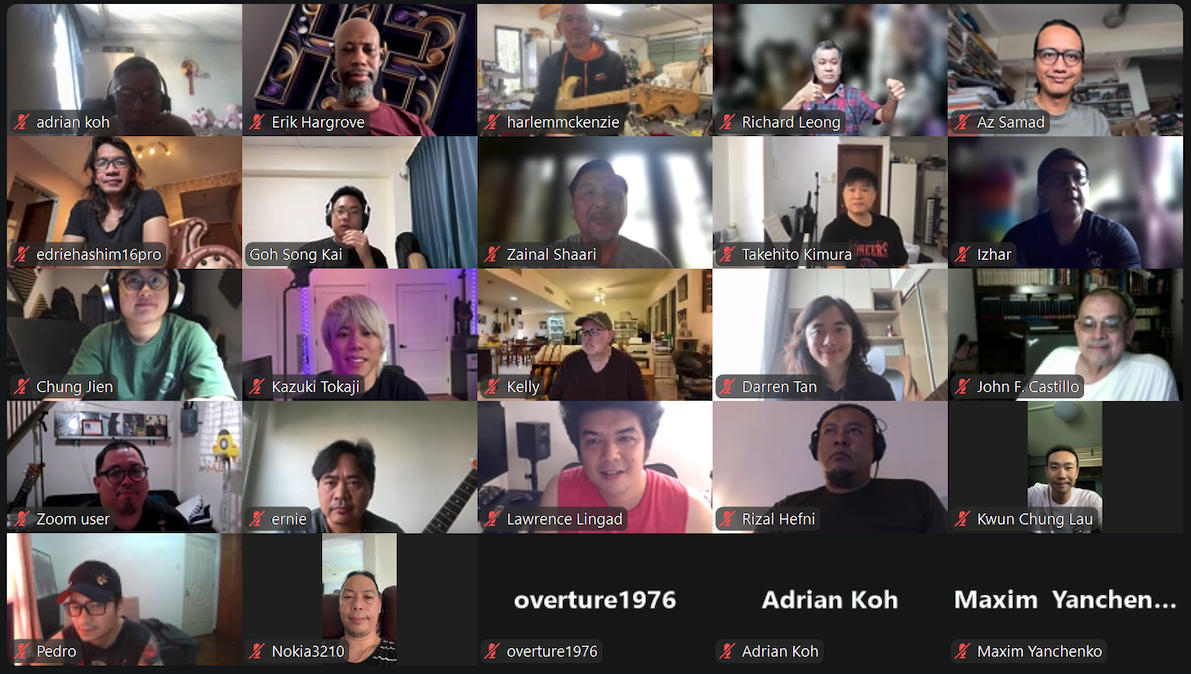
All photos courtesy of Anthony Poi. Thank you!
[Review Archive]
I wrote a lot of other book, course and video reviews too.
Check out the rest here:
[Read more reviews]
[Submissions for Review Consideration]
- Are you an author who wrote a jazz, guitar or music book?
- Have you created a DVD or an online video course or subscription based website?
- Would you like me to review your book/course?
Please send me a message at azsamad2 at gmail.com with:
For courses: a link to the course/video/product + access info etc.
For books: a link to the book (Dropbox) or PDF attachment (if it’s small) for review consideration.
Depending on whether I dig the book/course, I’ll let you know if I do plan to review it!
I cannot guarantee a review for every submission & if I’m not too into it, I may opt not to review it. I mean, it’s better to get a good review that for me to write a bad review just because it’s not a match for the kind of stuff I dig right? :p
NOTE: All reviews reflect my honest personal opinion so be aware that I will point out both cool Pros and Cons that I see in the work. You dig?