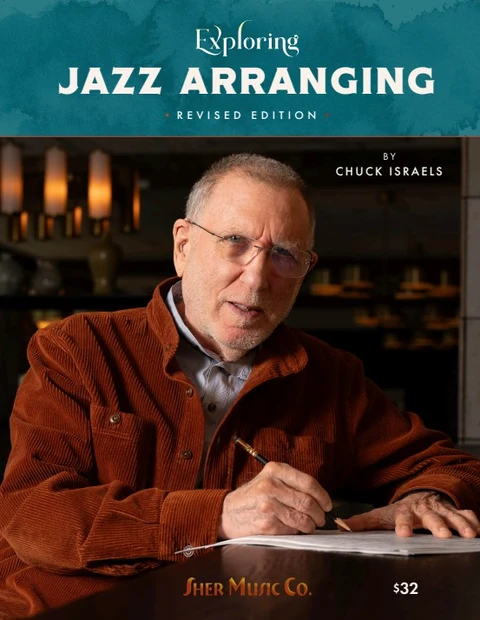
Today, I’m happy to share my thoughts on the book, Exploring Jazz Arranging (Revised Edition) by Chuck Israels from Sher Music. Chuck is a prolific and experienced musicians, perhaps most well known for playing in the Bill Evans Trio from 1961 to 1966.
Talking about arranging as a topic – when I did my first music degree, I majored in arranging at a contemporary music college in Kuala Lumpur, Malaysia. That was my first exposure to the world of arranging and throughout the five years doing my foundation and completing my first undergraduate degree, I learned many things both in class and in the real world.
Identifying as a music arranger (or perhaps more specifically being TRAINED as one) led me to approaching music in a different way over the years. These differences were not that obvious to me until friends would comment that I kept listening to music and analyzing what I heard all the time.
Was that due to my training, or was that me being obsessed about music?
Perhaps a little bit of both!
Anyhow, when I had the opportunity to check out a revised edition of this Chuck Israels arranging book, I was happy to go through it.
At 13 chapters and 195 pages, there is so much that Chuck Israels covers in the text. Besides the actual information and musical examples, the topic is taught in a organized and clear way that makes a lot of sense. One can easily be overwhelmed by the amount of things you need to know as an arranger (harmony, counterpoint, chord voicings, creating strong moving lines, countermelody writing, reharmonization), but Chuck does a great job at making sure the right amount of information is relayed in each chapter, in a gradual manner.
We start of with the important aspects of an arrangement – rhythm, bass lines, harmony, form, melody & orchestration, before going into the rhythm section, writing for two, three, four or more voices and then writing for the whole band (winds, rhythm, big band) and writing for singers.
The musical examples of course are what makes the difference in an arranging book, and boy there’s a lot of great ones included. In addition to the notated examples, you also get to download audio versions of these so you can hear these things in context.
In conclusion, this book provides a systematic overview of the considerations and concepts needed to craft great jazz arrangements. The fact that Chuck Israels has managed to condense so much of these ideas in a single book prove to be so valuable for any arranger who wants to revisit fundamentals and refine their craft.
Pros: A wonderful book from an experienced musician, with well organized information.
Cons: Not an introductory jazz theory text, the book assumes a baseline understanding of chord scales and notation.
TLDR: For the serious jazz arranger and performer, this book will be a great addition to your arranging library.
Get the book and eBook versions here directly from Sher Music Co:
https://www.shermusic.com/products/exploring-jazz-arranging-revised-edition
Many thanks to Chuck Sher for sending me a copy of this amazing book for this review. I deeply appreciate it.
[Review Archive]
I wrote a lot of other book, course and video reviews too.
Check out the rest here:
[Read more reviews]
[Submissions for Review Consideration]
- Are you an author who wrote a jazz, guitar or music book?
- Have you created a DVD or an online video course or subscription based website?
- Would you like me to review your book/course?
Please send me a message at azsamad3 at gmail.com with:
For courses: a link to the course/video/product + access info etc.
For books: a link to the book (Dropbox) or PDF attachment (if it’s small) for review consideration.
Depending on whether I dig the book/course, I’ll let you know if I do plan to review it!
I cannot guarantee a review for every submission & if I’m not too into it, I may opt not to review it. I mean, it’s better to get a good review that for me to write a bad review just because it’s not a match for the kind of stuff I dig right? :p
NOTE: All reviews reflect my honest personal opinion so be aware that I will point out both cool Pros and Cons that I see in the work. You dig?
Leave a Reply