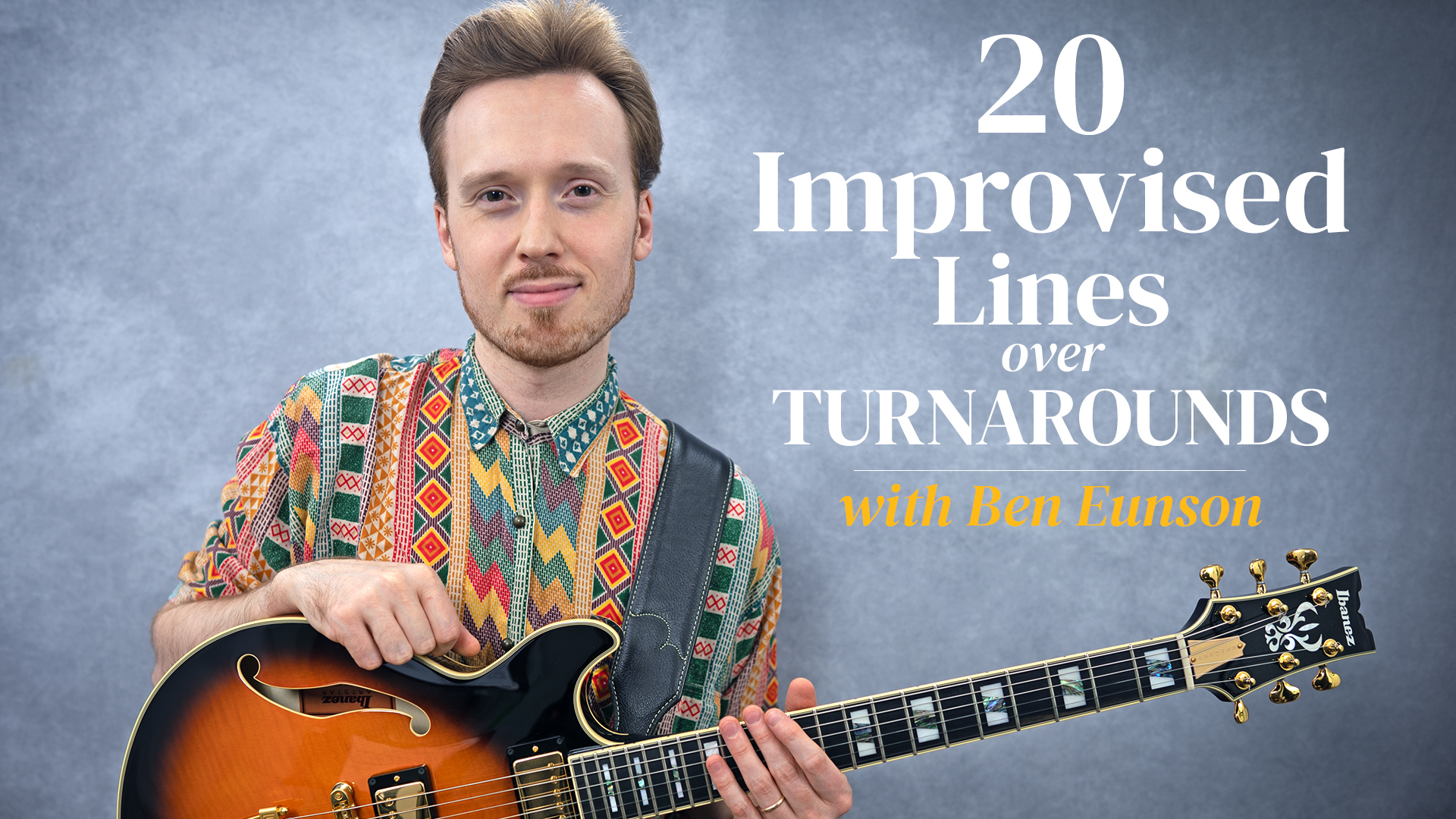
I’ve been a long-time fan of Ben Eunson’s courses and eBooks. Over the years, his materials have been instrumental in helping me get out from my comfort zone on the guitar, and get more flowing ideas into my playing.
This masterclass features 20 exercises utilizing 10 variations on the I-VI-ii-V progression (notated in both standard notation and tablature).
Before going into those exercises, Ben gives us three introductory exercises to begin the process. He includes voiceled chord voicings, triad and 7th chord arpeggios that give the sound of turnaround in both our ears and fingers.
Then, we go through 10 sections, each with two lines that demonstrate each of the 10 variations on the I-VI-ii-V progression.
In Section 1, we get two lines that are very much already in what I consider the distinctive Ben Eunson style – including a lot of legato phrasing and also wide stretches (perfect 4th, 6 frets apart on a single string) which create a more modern sound. I love these ideas, though for me I find that I need to take these lines very slowly and in small fragments to internalize them.
If you haven’t played lines that have these kinds of stretches, I recommend taking these slowly to not hurt your hands. Also, low action and higher gain might be helpful to make these legato ideas flow better.
In Section 2, we get our first substution which creates a different kind of diminished sound and introduced the diminished scale into the mix. Both these lines are interesting and have some cool melodic shapes to outline these changes.
Moving on to Section 3, Ben shares his take of the introduction of 13(b9) sounds. The first example has a nice mix of motivic playing and through composed. The second line also has cool shapes using the diminished scale that flow nicely.
For Section 4, we get altered scale ideas thrown into the phrases and in my opinion the first example for this one is absolute perfection. It’s probably my favorite line so far for this video. The second example is pretty as well, though I like the first one more.
In Section 5, the turnaround idea changes into a III-VI-II-V progression, which a slight variation of the standard I-VI-II-V. Both lines here include different kinds of technical challenges but still are very musical.
Section 6 has us exploring another more common tritone substitution in the chord progression. Both of the lines sound great!
Section 7 is similar to Section 6 but introducing descending dominants. The first line is more motivic and the second line is more through composed.
Section 8 is a tritone substitution focused variation with two great smooth lines just like the previous sections.
Section 9 is the most different turnaround because here Ben uses major7th chords instead of dominant chords. This changes the sound of the turnaround lines. The 1st line is very motivic and contrasted with a more involved line for the second example.
The closing section, Section 10 introduces a turnaround that I’ve never used. It’s surprising for me but logical. As I heard the first line, it had a Coltrane-inspired vibe based on the chord progression and I loved it.
After going through all the lines (not playing them all, but checking them out one by one) it is clear to me that this is a really cool course on not just the kinds of lines you can play on a turnaround but also the pure benefit of going deep into a subject like this. Ben gives us not only the chords progressions but in combination with his lines, all of this is powerful stuff that you can use as the basis of your own melodic improvisation or composition.
Honestly if you can play all the 20 lines in this video course/masterclass, you will likely see a significant increase in your chops and fretboard dexterity. While the total video runtime isn’t long, the physical and musical challenge Ben presents is very high.
In conclusion, this is a brilliant course for the right kind of person.
- Who it’s for:
- Fans of Ben’s modern legato style.
- Players looking to deepen their harmonic vocabulary over turnarounds.
- Intermediate to advanced players looking to push their technical limits.
- Who it’s NOT for:
- Absolute beginners or those lacking patience for high-level technical exercises.
- Players looking for “how-to-pick” tutorials (as the focus here is harmonic/melodic).
If you’re new to his style, I strongly recommend checking out either his warm-up course or How To Practice course first. Those are helpful to develop the chops needed for this kind of playing.
Pros: High-level melodic content that rewards deep, focused practice.
Cons: Minimal breakdown of technical execution (picking/fingering); focus is primarily on harmonic theory.
TLDR: If you dig Ben Eunson’s playing and want to get more ideas for soloing on turnarounds, this might be for you.
Full disclosure: I received a complimentary review copy of this masterclass from Ben Eunson, but the opinions expressed here are entirely my own.
You can get the video here: https://www.bensguitarclub.com/p/20-improvised-lines-over-turnarounds
[Review Archive]
I wrote a lot of other book, course and video reviews too.
Check out the rest here:
[Read more reviews]
[Submissions for Review Consideration]
- Are you an author who wrote a jazz, guitar or music book?
- Have you created a DVD or an online video course or subscription based website?
- Would you like me to review your book/course?
Please send me a message at azsamad3 at gmail.com with:
For courses: a link to the course/video/product + access info etc.
For books: a link to the book (Dropbox) or PDF attachment (if it’s small) for review consideration.
Depending on whether I dig the book/course, I’ll let you know if I do plan to review it!
I cannot guarantee a review for every submission & if I’m not too into it, I may opt not to review it. I mean, it’s better to get a good review that for me to write a bad review just because it’s not a match for the kind of stuff I dig right? :p
NOTE: All reviews reflect my honest personal opinion so be aware that I will point out both cool Pros and Cons that I see in the work. You dig?